

Our Popular Destinations in Tanzania
1. ARUSHA PARK:
WHAT TO SEE:
Ngurodoto Crater- a miniature crater about 2 kilometres wide and a few
feet deep with forested walls, Momella Lakes, Mt. Meru (4500M), Black &
white colobus Monkey, all kinds of Big African game except Lion and
Rhino. Hundreds of different species of sedentary birds to include the
Silvery cheeked Hornbill, Hertlaub`s Turaco, Giant Kingfisher, a variety
of wadders and Divers including Lilly troters, Yellow billed Stork and
the Maccoa Duck respectively. Accommodations shall be arranged in Arusha
Town.
*Access: A 45 Minutes
drive from Arusha Town.
SAFARI HIGHLIGHT:
Impressive views of Mount.Meru(4566 Metres), Elephants and Buffaloes,
Maasai Giraffes, a variety of beautiful Birds most of them endemic to
East Africa.
BEST TIME TO VISIT: All year around except April and mid May.
2. NGORONGORO CRATER:
Quote: "It could be a dream, out of the morning mist, men in red with
spears suddenly appear as an Antelope crashes out of the forest while a
herd of Buffaloes move towards a herd of indigenous Cattle led by a
lonely Maasai herdsman and at a stone throw in the plains are Zebras,
Wildebeest and Gazelles keeping an eye on a pride of Lions wallowing in
the grass with a Hyena pretending to be watching a flock of thousands of
pink coloured Flamingos on the crater lake.... We must be in the Garden
of Eden." A safari member said in amusement. Come and see for your self
the only Natural house in Africa where wild life concentration lives
permanently.
This is popularly known as the "Eighth wonder of the world", Noah's ark,
the Eden of Africa... etc. This is the land of the Maasai pastoralists
seen grazing cattle and Buffaloes, calves and Antelopes along side, it
is land of the Maasai with their cattle, of their flora, and of their
fauna. The protected area is home to over 30,000 Mammals, over 600 Bird
species, the gigantic earth fracture, crater floor, volcanoes, plains,
lakes, forests, archaeological site of Olduvai gorge, the great Rift
valley wall- all combine to form the Ngorongoro conservation Area.
Caution! Double check your filming materials before descending to the
crater floor, photo taking never seems to end at the Ngorongoro crater
floor. floor. The Golden winged Sun bird ,the Tacazze Sun bird and the
Living Livingstone's Turaco, the Endemic Rufous tailed weaver and the
Jackson's Widow bird will be some of the special Bird species of the day
to look out for while in the Ngorongoro.
BEST TIMES TO VISIT: All year except the rainy April. Come and see
* Access: 4 Hours drive from Arusha in a 4 WD Vehicle
3. LAKE MANYARA PARK
WHAT TO SEE:
This is where Florists and Botanists as well as Birders meet their
world. A variety of vegetation species occur, ranging from monotone
forest vegetation to plain savannah grassland. Here the Natural world is
for you; spot tree climbing lions, zebras, Maasai giraffe and the
breathe taking view of the spectacular lake Manyara. Bird life is
prolific as you approach the lake shore, a variety of Gulls may be
spotted and may be the Vulturerine Guinea fowl,Blue napped mouse Bird
and the mountain Wagtail.
SAFARI HIGHLIGHT:
Lake Manyara has the highest density of Elephants in East Africa ( at
least 7 Elephants per sq kilometre). A profusion of colourful Birds
awaits your discovery in the ground water forest as you spot pelicans
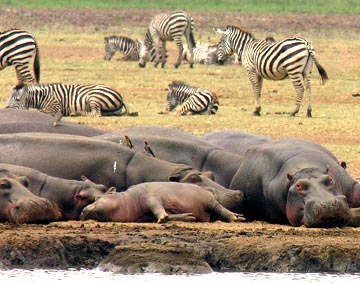
and cormorants swimming among walloping Hippos and Flamingos in their
pink on the lake. You will be able to update your Bird check list while
in Lake Manyara, do not miss to visit the Hippo pool.
BEST TIME: Non stop visit to lake Manyara, all year round.
* Access:3 hours Drive in a 4WD vehicle from Arusha
4. TARANGIRE PARK
It Neighbours with lake Manyara Park, ecosystem almost similar.Covers an
area of 2600sqKm.With large herds of Elephants, Thomson and Grant's
Gazelles, Gerenuk and Oryx may be spotted.
SAFARI HIGHLIGHT:
Best for the famous Baobab tree, Maasai giraffe & a birders paradise.
The endemic Bird species include Ashy starling, Yellow collared Love
bird and the Rufous tailed weaver can be found here.Other specialities
include Yellow breasted Apalis, Slender Tailed Night jar, Lilac breasted
Roller,Black faced Sand grouse ,Coqui Francoline ,Magpie shrike and the
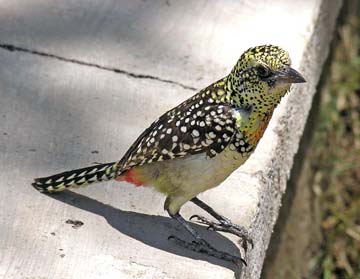
Red and yellow Barbet.
BEST TIME TO VISIT: June through December and January to mid April
* Access : 2 Hours Drive from Arusha in a 4WD Vehicle.
5. SERENGETI NATIONAL PARK
This continues great Eco system into the Maasai Mara of Kenya is the
oldest and largest wildlife park in East Africa with a total land area
of over 250000sq kilometres. Siringet (Now Serengeti) is a Maasai word
for "flat endless plains". Indeed your eyes, Scopes and Bins will be the
limit to the freely roaming wildlife in the Serengeti country.
WHAT TO SEE:
The wildebeest migration from Serengeti to Maasai Mara in Kenya and Vice
versa. All the big cats and, the Big five except the Rhino may be
spotted on a two to three days game drive depending on luck in the
wilderness.
SAFARI HIGHLIGHTS:
Wildebeest migration between June - October and December to May. Each
year at about this time of the year, over a million large Mammals
including Grazers and Carnivores come together to breed, a sight that
even a fanatic Birder will find irresistible to ignore. This is the only
place in East Africa with the highest concentration of wild life "The
Serengeti shall never die". Two Tanzania endemic bird species occur in
the Serengeti - the Fischer's Love bird and the Grey breasted Spurfowl.
Other specialities in the Serengeti include the Usambiro Barbet, Yellow
throated Sand grouse and the Silver bird...the list is endless.
BEST TIME TO VISIT: June through October, December and May.
* Access : 6 Hours from Arusha in a 4WD Vehicle.
6. MIKUMI NATIONAL PARK:
This small Wildlife Jewel is dominated by Hills and Plains as well as
part of the famous Miombo Woodlands, these varied habitat is an
excellent spot of several special and rare Wildlife not seen any where
in Tanzania.
SAFARI HIGHLIGHTS:
Rare Species such as the Wild Dog, Sable Antelope, Greater Kudu and Roan
Antelope have been recorded in Mikumi National Park. Bird Watchers may
be in position to spot Miombo woodland specialities such as Racket
Tailed Roller,Pale billed Hornbill, Shelley`s Sunbird, Wood Hoopoes and
Hoopoes. The Boem`s Bee-eater and the Miombo Rock Thrush are the few
other Species to add on.
BEST TIME TO VISIT: Except March, April and May.
*Access:4 hours Drive in a 4WD from the Coast of Dar es salaam.
7. UDZUNGWA MOUNTAINS PARK:
NOTE: It is possible to base from Mikumi to access the Southern
Highlands such as the UDZUNGWA MOUNTAINS National Park for the Southern
Tanzania Endemic species as well as access the Ifakara area and the
Kilombero Flood plains with her specialities and rarities. Accommodation
in Ifakara and Udzungwa is basic.
The greatest altitudinal range of forests in East Africa: The eastern
escarpment is the only place in East Africa with unbroken forest cover
from lowland forest communities at below 250km above sea level, through
intermediate types, to mountain communities at over 2,000m.
Exceptionally species-rich forest: The Udzungwa contain plant species
found nowhere else in the world, ranging from a tiny new African violet
to 30m high trees.
Rich primate fauna: The park hosts six species of primate, two of them
endemic forms - the Iringa (Uhehe) red colobus monkey and the Sanje
Crested Mangabey. The latter was only discovered in 1979.
Diverse large mammal community: The plateau contains resident
populations of elephant, buffalo, lion, leopard, wild dog, sable
antelope, eland and water buck. there is also a rich small bovid
community, with good numbers of red, blue and abbots duikers and
bushbuck.
Richest forest bird habitat in Tanzania with several endemics. Recent
studies have added several new species the park's bird list (including a
new species of francolin.) This gives the Udzungwa forests a ranking in
the top three areas important for bird conservation in mainland Africa.,
Spectacular mountain scenery with rainforest, wooded grasslands, rock
faces, rivers and waterfalls: The falls on the Sanje River drop some
170m through the forest to the valley below. The mountain plateau allows
views of over 100km.
8. USAMBARA MOUNTAINS AND AMANI
NATURE RESERVE.
This little-known mountain range is one of the gems of Tanzania. Lying
north coast, the Usambara’s are a relict patch of the great tropical
forests that once spanned Africa from the Atlantic to the Indian Oceans,
and have more in common with the forests of West Africa than those of
East Africa . The Usambaras are a treasure house of botanical and
zoological and Ornithological diversity, with a huge number of endemic
tree and plant species and the Birds of course... Although large tracts
of the original forests have been levelled for tea planting, enough of
the original wilderness remains to make this a hiking, birding and
primate-spotting paradise.
Birders will want to keep eyes open for most of the species that are
endemic to the Usambara forests and Tanzania in particular – the
Usambara eagle owl, Usambara alethe and the Usambara weaver are among
others. This is one of the best places in East Africa to see notable
birds like the green-headed oriole, Amani sunbird, bar-tailed and Narina
trogons and Fischer’s turaco. Amani was once a resort for holidaying
German officials, and there is a basic guesthouse and a campsite set
amidst the spectacular forest. The Amani Nature Reserve is an
extraordinary place for botanical study. Within its boundaries there are
many endemic tree species as well as an interesting relationship between
the high level of floral endemism and invading species.
9. PEMBA ISLAND:
Often forgotten on many birding or beach holidays is Pemba Island ,Pemba
is a sister island to the famous Zanzibar. Pemba is surrounded by
beautiful coral reefs of every form and description, beautiful smaller
islands, deep channels and exotic white sandy beaches. In short, it is
the "Forgotten Paradise" of Tanzania’s East Coast. The island itself is
covered by dense rainforest in the north and rich fertile soil where
huge bananas and mangoes grow like weeds, together with coconuts,
lychees and of course cloves. With its extremely rich species
biodiversity it is an island of considerable scientific importance.
Pemba is a perfect place to start or end any bird tour, and even for non
birders.The remote location of the island gives visitors a chance to
explore old Africa through excursions such as village walks,cycling and
of course the beach sports. For birders , it is only on Pemba that you
will catch up with 4 of the Tanzanian Endemics to include: The Pemba
scops Owl, Pemba sun bird, Pemba White eye and Pemba Green Pigeon, yet
the number of coastal specialities are un-beatable.v You could Fly to
Pemba out of Dar es Salaam or Tanga before or after doing the Usambara
mountains.
10. LAKE VICTORIA:
Shared between the three of the East African Countries – (
Tanzania,Kenya and Uganda ), Lake Victoria is the Largest Fresh water
lake in Africa commonly regarded as Africa`s Inland sea. Famous
Explorers like John Hanning Speke on their exploration of Africa
discovered Lake Victoria in 1858.Though rarely visited by many Visitors
to east Africa,we at Birding & Beyond Safaris, do include Lake Victoria
on many our of trips so as to be able to catch up with the Lake zone
specialities not found off the lake zone.The red Chested
Sunbird,Northern brown throated & Slender billed weavers, Night jars,
Senegal and Blue Headed Coucal, Black headed Gonolek and a number of
waders and shore birds to add onto your list ……. are restricted to
lake Victoria. It is a shame for any keen birder to visit the Serengeti
and not get as far west as Lake Victoria to catch up with these
specialities.
11. KILOMBERO FLOOD PLAINS AND
WETLAND:
We do include the Kilombero Flood plains and wetland on many of our
Southern Tanzania bird tours. This is where the new un described species
occur. The Kilombero weaver and Kilombero Cisticolas and several other
specialities are found here. A visit to the Udzungwa Mountains or Mikumi
National Parks can be combined with an excursion to the Flood Plains
alittle further South.
12. RUAHA NATIONAL PARK:
Ruaha National Park is Tanzania's least accessible parks and poorly
visted and as result it is totally untouched and remains one of the most
exciting game reserves (almost as large as the Serengeti) in Tanzania.
We do include Ruaha National park on many of our off track safaris.
Ruaha is exciting and regarded as a birdwatcher's paradise as there are
350 species of bird that are not found in northern Tanzania and as the
river runs through spectacular gorges and majestic trees it is specially
appealing to photographers. The new Ruaha Redbilled( Tanzania Redbilled
) Hornbill, another one of the Tanzanian endemics is localized in Ruaha.
Most of the big game: elephant; buffalo; hippos; crocodiles; lion;
cheetah; leopard; wild dog and lots of antelope; Greater and Lesser
Kudu; roan and sable antelope; and Grants gazelles are found in the
Ruaha. Ruaha's unusually high diversity of antelope is a function of its
location, which is transitional to the acacia savannah of East Africa
and the miombo woodland belt of Southern Africa. Grant's gazelle and
lesser kudu occur here at the very south of their range, alongside the
miombo-associated sable and roan antelope, and one of East Africa`s
largest populations of greater kudu, the park emblem, distinguished by
the male's magnificent corkscrew horns.
BEST TIME TO VISIT:
For predators and large mammals, dry season (mid-May-December) and for
bird-
watching, lush scenery and wildflowers visit in January through June.
13. SAADANI NATIONAL PARK
- "where the beach meets the bush"
This is East Africa’s only National Park by the beach.At Saadani
National Park, Palm trees sway in a cooling oceanic breeze. White sand
and blue water sparkle alluringly beneath the tropical sun. Traditional
dhows sail slowly past, propelled by billowing white sails, while
Swahili fishermen cast their nets below a brilliant red sunrise.
Saadani is where the beach meets the bush. The only wildlife sanctuary
in East Africa to boast an Indian Ocean beachfront, it possesses all the
attributes that make Tanzania’s tropical coastline and islands so
popular with European sun-worshippers. Yet it is also the one place
where those idle hours of sunbathing might be interrupted by an elephant
strolling past, or a lion coming to drink at the nearby waterhole.
Protected as a game reserve since the 1960s, in 2002 it was expanded to
cover twice its former area and up garded to National Park status.
Today, a surprisingly wide range of grazers and primates is seen on game
drives and walks, among them giraffe, buffalo, warthog, common
waterbuck, reedbuck, hartebeest, wildebeest, red duiker, greater kudu,
eland, sable antelope, yellow baboon and vervet monkey. Herds of up to
30 elephants are encountered with increasing frequency, and several lion
prides are resident, together with leopard, spotted hyena and
black-backed jackal. Boat trips on the mangrove-lined Wami River come
with a high chance of sighting hippos, crocodiles and a selection of
marine and riverine birds, including the mangrove kingfisher and lesser
flamingo, while the beaches form one of the last major green turtle
breeding sites on mainland Tanzania.
WHEN TO VISIT:
Generally accessible all-year round, but the access roads are sometimes
impassable during April and May. The best game-viewing is in January and
February and from June to August
ACCOMMODATION:
One luxury tented camp.
Campsites planned.
14 :KITULO PLATEAU NATIONAL
PARK "the Garden of God"
Locals refer to the Kitulo Plateau as Bustani ya Mungu – The Garden of
God – while botanists have dubbed it the Serengeti of Flowers, host to
"one of the great floral spectacles of the world". And Kitulo is indeed
a rare botanical marvel, home to a full 350 species of vascular plants,
including 45 varieties of terrestrial orchid, which erupt into a riotous
wildflower display of breathtaking scale and diversity during the main
rainy season of late November to April.
Perched at around 2,600 metres (8,500 ft) between the rugged peaks of
the Kipengere, Poroto and Livingstone Mountains, the well-watered
volcanic soils of Kitulo support the largest and most important montane
grassland community in Tanzania.
One of the most important watersheds for the Great Ruaha River, Kitulo
is well known for its floral significance – not only a multitude of
orchids, but also the stunning yellow-orange red-hot poker and a variety
of aloes, proteas, geraniums, giant lobelias, lilies and aster daisies,
of which more than 30 species are endemic to southern Tanzania.
Big game is sparsely represented, though a few hardy mountain reedbuck
and eland still roam the open grassland.
WHEN TO GO:
Wildflower displays peak between December and April. The sunnier months
of September to November are more comfortable for hiking but less
rewarding to botanists. Conditions are cold and foggy from June to
August.









Home | About us | Destinations | Trip reports | Our Fleet | Memories | Contact us